
Recent inquiries from international contacts have prompted this analysis. Several questioned the veracity of industry claims about a property recovery – some noting, not without irony, that the recovery narrative has been a fixture of market commentary since last year, even as a series of headwinds accumulated: the Thailand border conflict and its drag on regional commerce, Iran-related disruptions to oil markets that pushed up shipping costs and construction material prices, the contraction of the workforce tied to scam-compound operations, and the suspension of banks and financial institutions operating on the periphery of proper financial governance. The cumulative effect on investor confidence, capital flows into projects, and general economic demand has been real – and a few contacts raised the blunter question of whether the recovery story is credible at all, or whether it risks further eroding Cambodia’s image at a time when facts and promotional claims are visibly misaligned.
The short answer is that the market is more complicated than either the promoters or the skeptics suggest.
What the data actually shows
Two indicators released in recent months point in opposite directions – and both are accurate:
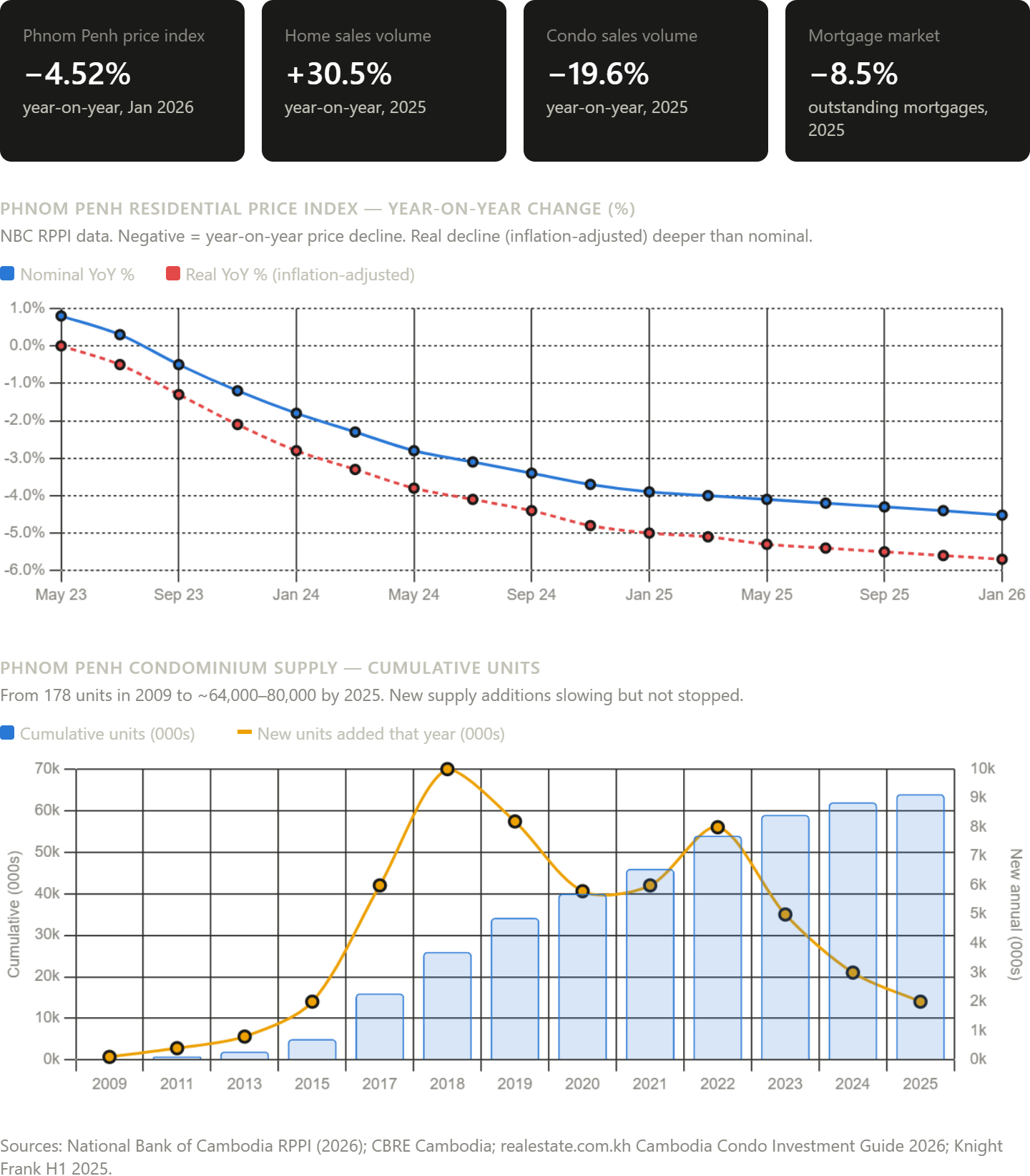
- Home sales volumes rose 30.5% in 2025 – the number industry commentators are leading with
- Condominium sales fell 19.6% in the same period, reversing the prior year’s growth
- The NBC’s Residential Property Price Index recorded nine consecutive months of year-on-year decline in Phnom Penh as of January 2026, with real prices down 5.7% when adjusted for inflation
- Total condominium supply has reached 64,000–80,000 units in Phnom Penh depending on methodology, with four new projects launched in Q1 2026; Knight Frank reported average sales rates at 3–4%, the lowest in recent decades
- The mortgage market contracted 8.5% in 2025 – the second consecutive annual decline after a decade of strong growth
The volume recovery and the price recovery are different things. Industry commentary has tended to conflate them.
Why boreys are performing and condominiums are not
The volume rebound is concentrated in the borey segment – gated landed housing developments. This reflects something structural about Cambodian housing preferences: most Cambodian families, across income levels, still prefer landed property. Even boreys in peripheral locations with documented quality concerns continue to find buyers, because the cultural and practical pull of land ownership remains strong, and because the payment terms – including interest-free installment plans now offered during construction on some projects, a relatively recent developer adaptation to the contracting mortgage market – make entry accessible. Wealthier and younger elite families have embraced condominium living, but this remains a narrow demographic. The condominium market was built for a buyer base – foreign investors and the domestic top tier – that has partially withdrawn, and the cultural substitution from landed preference to high-rise living has not materialized at scale.
The structural gap neither market is addressing
Both the condominium overhang and the borey recovery point to the same underlying failure: the market has never been built for the majority. The P50–P80 income segment – households earning a combined $900–$1,200 per month, representing over 40% of housing demand – has virtually no formal housing options. These households already pay $300–$400 monthly in rent. JICA estimates Phnom Penh needs 8,000 units per year for this segment. Current purpose-built supply is negligible.
What this segment needs is not charity housing or remote low-cost units that tick affordability checkboxes on paper. It needs quality homes in accessible locations at attainable prices – roughly $45,000–$65,000 with bank-enforced hard-title financing rather than developer installment arrangements that leave buyers exposed if a project stalls or a developer defaults.
A few observations
The government’s February 2026 Social and Affordable Housing Development Policy moves in the right direction – formally defining affordability, introducing rental housing provisions, and establishing developer incentives. But a funded delivery mechanism has yet to be operationalized. Logic and regional precedent suggest that addressing this gap at scale will require a dedicated housing financing facility and institutional lending protocols with hard-title protection from project launch. The more fundamental question, even assuming such architecture is established, is whether it will attract the right projects – or whether capital will gravitate toward the lowest-cost, most remote developments that satisfy definitions while missing the market.
The P50–P80 segment’s purchasing power is demonstrably present. Its housing supply is not. The developer or investor who closes that gap – at quality, in viable locations, at prices Cambodian working families can actually reach – will not be solving a social problem. They will be meeting the largest unaddressed demand signal in Cambodia’s property market.
Sources: NBC Residential Property Price Index and 2025 Annual Report (January 2026); realestate.com.kh Cambodia Condo Investment Guide 2026 (March 2026); IPS Cambodia (February 2026); Knight Frank Cambodia Real Estate Highlights H1 2025; Global Property Guide (March 2026); AMRO 2025 Annual Consultation Report; World Bank Cambodia Economic Update (June 2025); IMF Article IV Consultation (January 2025); JICA middle-income housing projection (via Cambodianess, December 2025); Royal Government of Cambodia Social and Affordable Housing Development Policy (February 13, 2026).