
Two separate readings of Cambodia’s economic data last week arrive at the same place. Trade figures show Vietnam and Singapore absorbing import share that Thailand once held — most visibly in food and consumer goods. FDI data shows Cambodia attracting record manufacturing investment — led by garments, footwear, and travel goods, but extending into electronics, automotive assembly, and light manufacturing — yet the dominant model remains labor-intensive and import-dependent, with limited upstream processing depth.
Both threads point to the same structural gap: Cambodia generates significant agricultural and industrial output and captures relatively little of its value.
The gap, quantified
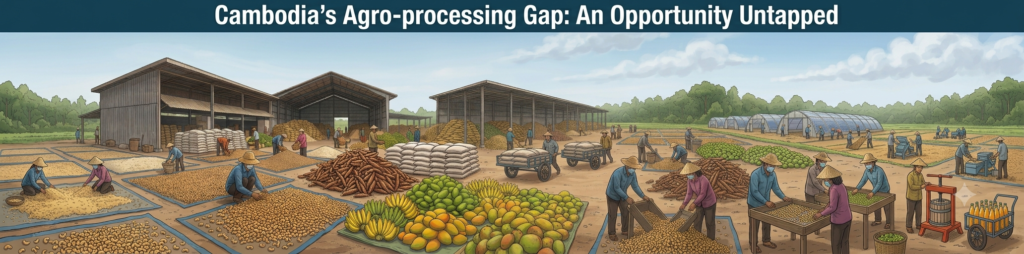
By ADB estimates, only around 10% of Cambodia’s food exports are processed domestically. The rest — cashews, cassava, mangoes, soybeans, rubber, rice — leaves the country as raw material, gets processed in Vietnam or Thailand, and often returns as finished goods consumed back in the Cambodian market. The country is, in effect, subsidizing its neighbors’ value-added manufacturing with its own agricultural output.
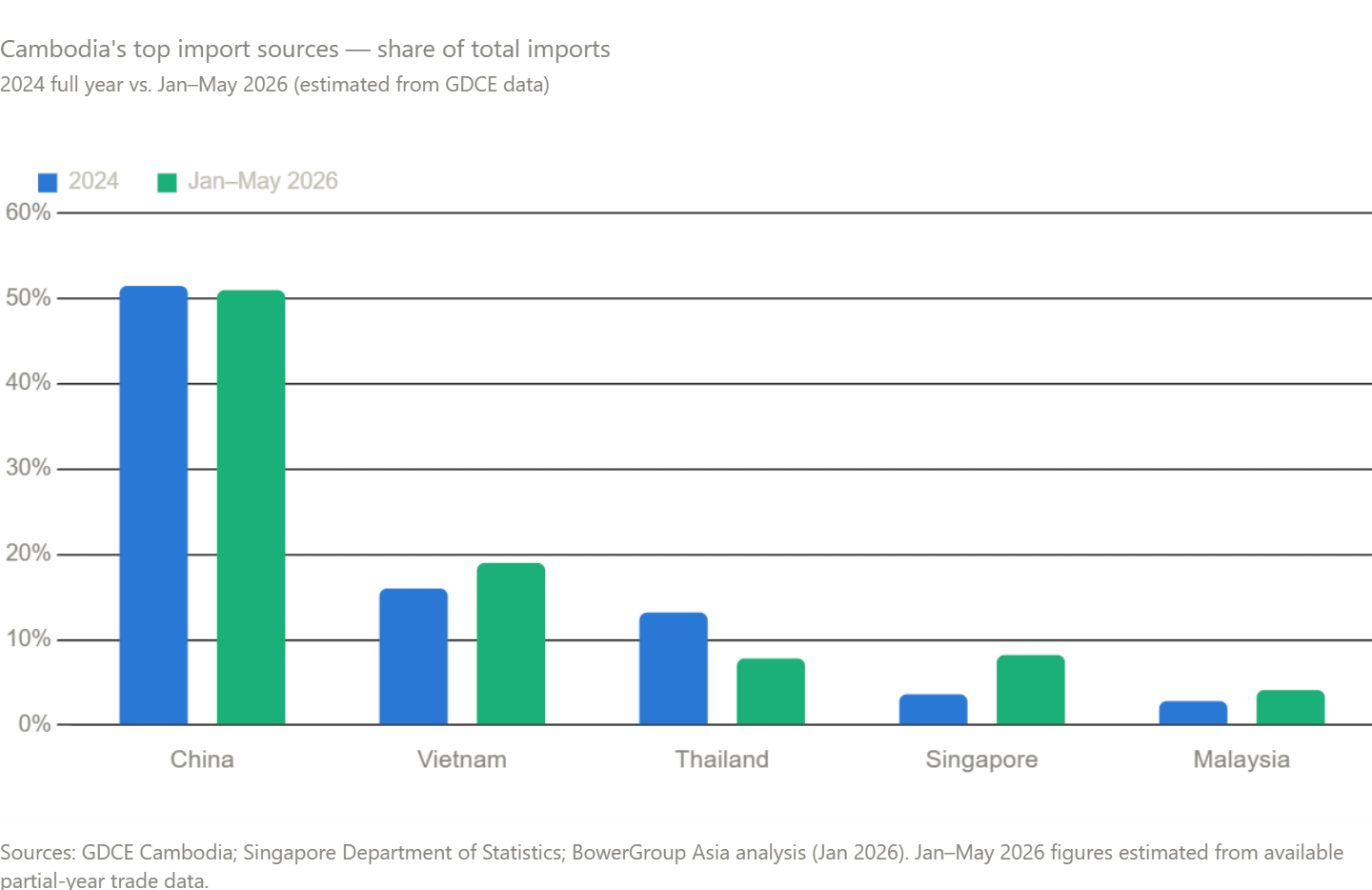
The border disruption with Thailand — which has closed land crossings since mid-2025 — made this dynamic acutely visible. Cambodia experienced localized food shortages not for lack of raw materials but for lack of processing capacity. The government’s response, a public Buy Cambodian campaign and a Ministry of Commerce acknowledgment that the moment presents “one of its best opportunities” for domestic industry, confirms the diagnosis. Whether the investment conditions now exist to act on it is the more useful question.
Where the raw material base sits
Cambodia’s agricultural foundation is stronger than its processing record suggests. Key commodities with underexploited processing potential include:
- Cashew — Cambodia ranks among Southeast Asia’s leading producers, yet most nuts are exported raw for processing elsewhere
- Cassava — substantial output, largely shipped unprocessed to Vietnamese and Chinese buyers
- Rice — export reach has expanded, but milling and value addition remain underdeveloped relative to regional competitors
- Rubber, pepper, and plantation timber — a base that, on paper, supports a much larger downstream industry than currently exists
The constraint has not been supplied. It has been a combination of limited processing infrastructure, high energy costs, thin technical labor, and a domestic market that has historically been adequately served by cheaper processed imports from across the border.
The entry points for investors
For an overseas investor or trader, the case for agro-processing in Cambodia does not have to start with a processing plant. The simpler near-term plays are trading and off-take arrangements: sourcing Cambodian agricultural commodities at the raw material stage, establishing supplier relationships that anchor a longer-term investment decision, or providing the cold chain and post-harvest handling infrastructure that currently constrains domestic processors from scaling. These are lower-commitment entry points that can inform a larger position without requiring it.
For those with higher appetite, the mid-scale food processing gap — canned goods, ready-to-eat meals, processed protein, packaged agricultural derivatives — is real, government-acknowledged, and undersupplied. The sector qualifies for QIP incentives, including multi-year corporate income tax exemptions, and aligns with Cambodia’s stated industrial development priorities under the Pentagonal Strategy.
Notably, the Enterprise Singapore delegation that met CDC leadership in May 2026 at the Cambodia Investment Forum focused specifically on agriculture and agro-industry — rubber processing, cashew production, plantation timber. That institutional attention reflects where Singapore’s commercial community sees Cambodia’s investable edge, and it is consistent with what the underlying data supports.
What to be realistic about
The structural opportunity is genuine, but entry conditions carry constraints worth weighing:
- Energy costs remain above regional comparators, bearing on operating economics for processing operations
- Skilled technical labor in food processing is limited and will require investment in training alongside any facility build-out
- Export-oriented processing depends on Cambodia maintaining preferential market access — to the EU under EBA, and to the US at the recently confirmed 19% tariff rate, neither of which is unconditional
On the broader manufacturing question — whether Cambodia can attract investment that moves beyond assembly into genuine upstream integration — the data does not yet support a conclusion. That question bears monitoring as the 2025–26 investment approval cycle converts into operating capacity.
An Inconvenient Truth or Overlooked Opportunity?
The Thailand border disruption did not create Cambodia’s agro-processing gap — it surfaced a condition that has been present for decades. Both the trade rerouting data and the manufacturing FDI picture point to the same structural reality: Cambodia has the raw material base, the policy signals, and the emerging institutional interest from Singapore and elsewhere to support a more serious processing industry. What remains to be seen is whether investors move on it at a meaningful scale, and whether domestic conditions — energy, skills, logistics — improve quickly enough to make the economics work. The window is open; how long it stays that way will depend on factors both within and beyond Cambodia’s control.
Sources: GDCE Cambodia bilateral trade data (June 2026); Cambodianess (June 2026); Khmer Times (June 2026); Global Textile Times (June 18, 2026); Khmer Times / CDC — EnterpriseSG meeting (May 8, 2026); ADB Asian Development Outlook (April 2026); BowerGroup Asia (January 2026); Cambodia Investment Review; Vietnam News (June 5, 2026).