
Recent headlines on Cambodia’s economy have cut in different directions — trimmed growth forecasts alongside robust export and investment figures, softening tourist arrivals, and renewed calls to diversify sources of foreign investment. Conversations with international contacts over recent months echo that same mixed picture. The questions Aquarii hears most often, though, are not about megaprojects — those generate their own headlines. They come from smaller businesses: distributors, service operators, manufacturers, F&B and professional services firms asking whether Cambodia is worth a serious look. The answer, more often than the noise suggests, is yes.
A shorter shortlist
Part of the uptick in Cambodia interest reflects elimination rather than discovery. The shortlist of stable, accessible emerging markets has contracted. Several that once competed for the same investor attention now carry heavier freight: political transitions that have unsettled business confidence; rising costs that have compressed the margin advantage; foreign ownership structures requiring local partners; currency regimes that subject investors to exchange rate exposure twice — on conversion in and again on repatriation; and remittance frameworks that add friction to moving capital out.
Cambodia has not changed its fundamental rules. In a more complicated regional environment, that consistency is itself an advantage.
What the operating environment actually offers
HOW CAMBODIA COMPARES — KEY STRUCTURAL FEATURES FOR FOREIGN INVESTORS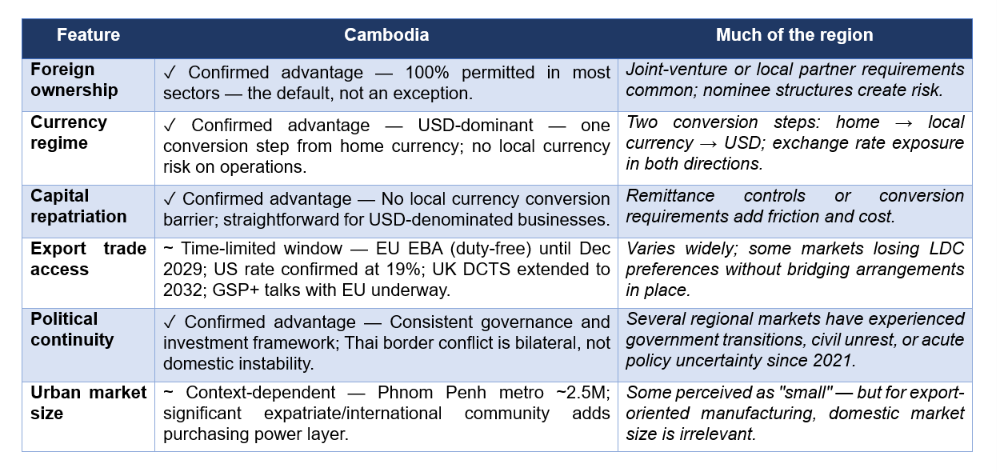 Sources: UK DCTS confirmation (January 2026); UN General Assembly Resolution A/79/L.49 (December 2024); Cambodia Law on Investment (2021); MacroTrends metro population data (2026). “Much of the region” refers to general patterns across South and Southeast Asian emerging markets — conditions vary by country and sector.
A few points from the table warrant fuller treatment:
On the USD economy: Most emerging market operations require two currency conversions, on both legs of the trade — capital coming in and profits going out. Cambodia’s USD-dominant economy removes that friction, which is a genuine comparative advantage over regional peers, not just a Cambodia-specific quirk.
- Typical emerging market: home currency → USD → local currency on the way in; local currency → USD → home currency on the way out for dividends and profits. Exchange rate risk and transaction cost at each step, both directions.
- Cambodia: a single, direct conversion to USD covers both capital inflow and repatriation. Day-to-day operations, pricing, and capital repatriation are all USD-denominated.
- Caveat: Cambodia is actively promoting greater Khmer Riel usage for monetary policy purposes — a direction that may evolve — but the current operating reality for foreign businesses remains USD-dominant.
On trade access and the LDC transition: Cambodia has been consistent in stating it will not remain dependent on preferential treatment. LDC graduation is confirmed, but the transition is being managed rather than abrupt.
- EU EBA (duty-free): in place until Cambodia’s LDC graduation, confirmed for December 19, 2029, per UN General Assembly resolution.
- EU GSP+: successor-arrangement discussions already underway ahead of the 2029 transition.
- UK DCTS: preferential access separately confirmed extended to 2032.
- Investor horizon: for three-to-five year horizons, current conditions remain intact; for longer horizons, the trajectory of engagement suggests a managed rather than abrupt transition. H1 2026 export performance seems to back that reading — Cambodia’s garment, footwear, and travel goods sector, still the largest user of these preferences, grew exports 6.2% year-on-year to $7.99 billion in the first half of 2026, alongside continued RCEP and bilateral FTA gains with China, South Korea, and the UAE. These are market indicators on the durability of preferential access with actual shipments.
On market size: Phnom Penh’s metropolitan area is approximately 2.5 million residents, growing at around 3% annually. This includes a significant expatriate and international professional community — embassy staff, NGO and IO personnel, international school faculty — whose purchasing power is rarely reflected in raw population figures but is directly relevant to F&B, professional services, retail, and education-adjacent businesses. For export-oriented manufacturing, domestic market size is beside the point.
The noise, in proportion
The concerns that give investors pause are real: scam-compound reputational overhang, the Thai border conflict, electricity costs above some regional comparators, banking sector NPLs approaching 9%. Those concerns now carry institutional weight. Three institutions, three numbers, three different emphases on 2026 growth:
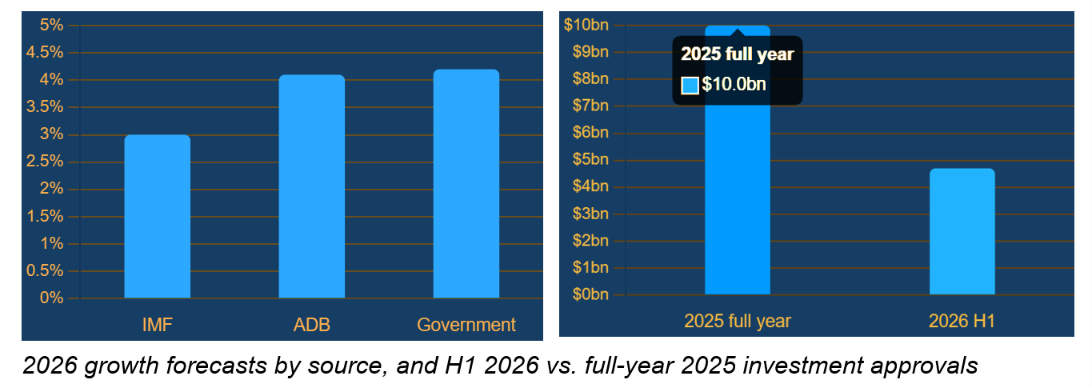
- IMF (July 2026 Article IV mission): 3.0% — cites higher energy prices, softer external demand, and reputational damage tied to scam activity weighing on tourism and financial stability.
- ADB (Asian Development Outlook, July 2026): 4.1% — a 0.4-point cut from its April forecast, pointing specifically to the prolonged Thai border closure.
- Cambodian government (Ministry of Economy and Finance): 4.2% — cites stronger-than-expected non-garment export performance and a $1.24 billion stimulus package.
Whose number proves closer to the mark won’t be clear until later in the year — but even the multilaterals’ more conservative reading keeps Cambodia ahead of several regional peers. Investment approvals, in any case, have not slowed: the CDC recorded $4.7 billion in fixed-asset approvals in the first half of 2026 alone, on pace to match or exceed 2025’s full-year $10 billion.
The investment the data misses
CDC statistics count registered capital and approved projects. They do not count the distribution agreement, the first franchise outlet, the sourcing relationship, the representative office. These are investments in the economic sense — they create employment, transfer skills and knowledge, and build the commercial infrastructure that larger commitments later rely on. In most economies, MSMEs account for the overwhelming majority of businesses and a disproportionate share of employment. Cambodia is no different.
The investor that fits naturally into this environment is not necessarily writing nine-figure checks. It is often one looking for a market where ownership rules are clean, the operating currency is familiar, the cost of entry is proportionate, and the conditions for doing business are consistent. On those criteria — against the current regional alternatives — Cambodia’s case is more accessible than its reputation tends to suggest.
Sources: IMF Article IV Mission press release (July 2026); ADB Asian Development Outlook (July 2026); Khmer Times, “MEF defies IMF outlook, bets on 4.2 percent growth” (July 2026); General Department of Customs and Excise H1 2026 export data via Xinhua (July 2026); CDC H1 2026 investment data via Xinhua (July 2026); UK DCTS — preferential access extended to 2032 (January 2026); UN General Assembly Resolution A/79/L.49 (December 2024); EU GSP+ transition discussions (March 2024); Cambodia Law on Investment (2021); NBC Cambodia 2025 Annual Report; MacroTrends / World Population Review — Phnom Penh metro population (2026); World Bank Global Economic Prospects (January 2026).