
International arrivals to Cambodia fell 47.8% year-on-year through May 2026 – the weakest month, May, brought just 232,000 visitors. 2025 was already a difficult year for the sector, with arrivals down nearly 17 percent, building into a much steeper slide through the first five months of 2026. Read at face value, the number looks like proof the sector is in freefall. A closer look at what it’s actually measuring tells a more useful story.
Sizing the decline
Land arrivals fell roughly 68% against a 20% decline in air arrivals over the same window – land crossings are tallied per checkpoint pass, not per unique traveler, and a real share of that traffic was never leisure tourism to begin with.
A rough accounting of the 1.41-million-visitor drop points the same direction:
- Thailand. Thai-origin arrivals fell from 856,169 in the first five months of 2025 to just 32,757 in the same window this year – a drop of roughly 823,000, well over half the total decline. It’s real demand loss, but it traces to the border closure – an external, force-majeure-type disruption outside tourism authorities’ or industry’s control – rather than any decline in genuine interest in Cambodia, and the figures are drawn straight from the Ministry’s own published data.
- Scam-crackdown departures. Departures and repatriations linked to the scam-compound crackdown account for a further few hundred thousand, alongside a dissuasion effect on would-be new arrivals that is real but not precisely quantifiable.
- Land-counting methodology. Historical land-border figures counted every checkpoint crossing rather than each unique traveler, inflating the pre-2026 baseline. The same structural issue shows up elsewhere in the Ministry’s own data: domestic tourism visits reported for the first five months of 2026 topped 20 million – more than Cambodia’s total population – a discrepancy industry figures have already flagged publicly, since the methodology can count each stop on a single journey as a separate visit.
- Airfares. Regional jet fuel prices roughly doubled after the US-Iran conflict disrupted supplies from late February 2026, pushing up the cost of getting to Cambodia at all.
- Itinerary exclusion. Multi-country regional itineraries tend to drop Cambodia first when travel budgets tighten.
- Reputational headlines. A small number of serious scam-related cases drew heavy coverage in some source markets, weighing on sentiment out of proportion to their share of actual tourist visits.
None of this is a precise reconciliation – these components interact with each other and with the land-counting effect, so they don’t sum cleanly against the total. But strip Thailand out along with the rest, and what’s left looks like a fraction of the headline number, not the number itself – even if the exact remainder can’t be stated with precision from published data.
None of this trivializes the downward pattern, or the work still needed. The residual – whatever its true size – is the part actually worth worrying about genuine travelers choosing not to come, rather than a group of visitors that was never really tourism, a border that happened to close, or a war six thousand miles away pushing up jet fuel prices. Prime Minister Hun Manet has himself pointed to safety perception as the downturn’s main driver, describing the scam operations as a black economy undermining the legitimate one – a problem this piece isn’t arguing away, only sizing correctly. The point of sizing the decline correctly isn’t to minimize it – it’s to make sure the response actually lands on the part that needs one.
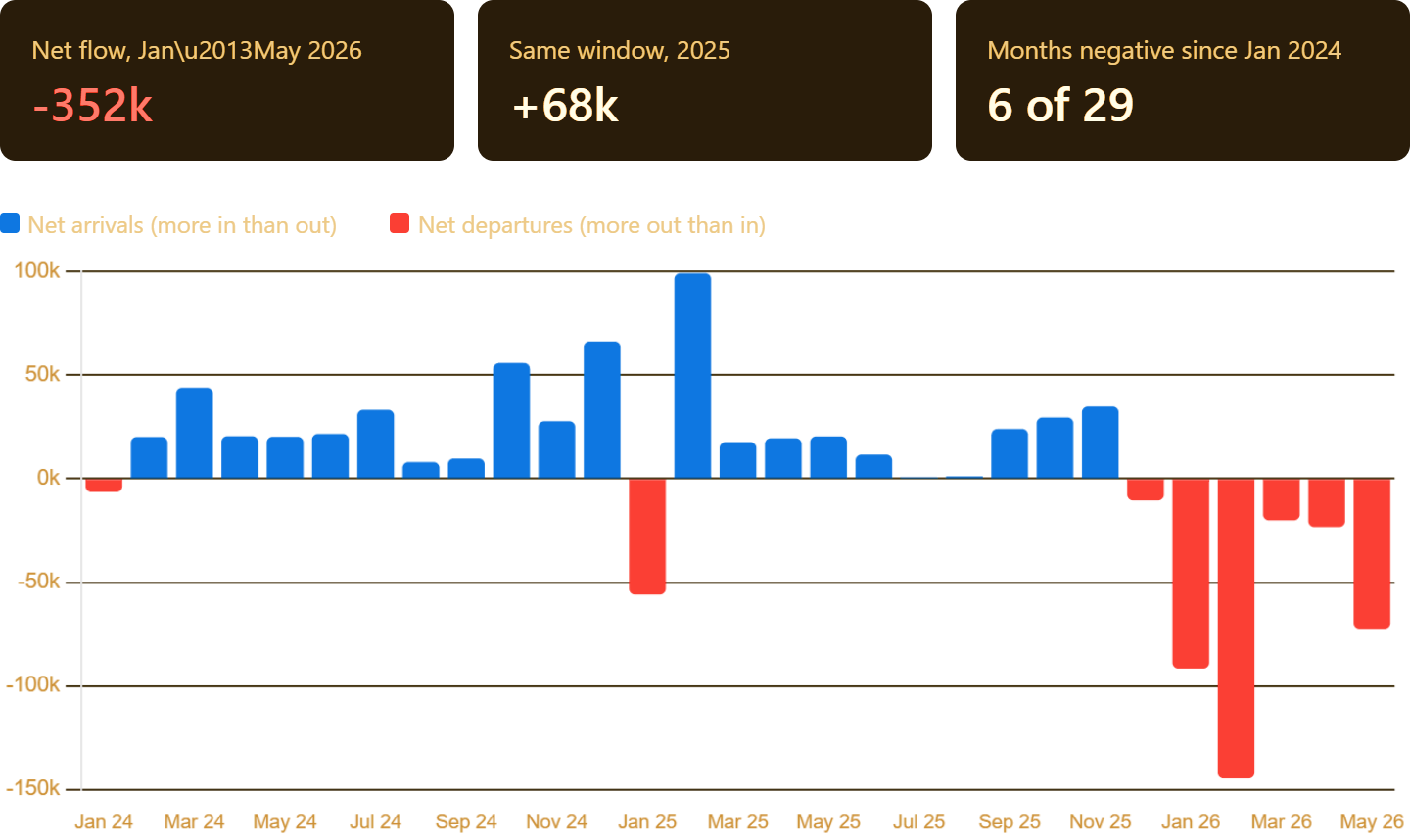
Source: Ministry of Tourism of Cambodia, Tourism Statistics Reports, January 2024–May 2026.
That pattern rules out the easiest objection – that this is normal seasonal churn. A sustained five-month net outflow, concentrated in the nationalities most associated with the scam-compound crackdown, looks like the exit of a group of visitors that was never counted as tourism correctly to begin with.
Why the sequence of analysis matters
This is where skipping straight to solutions causes the most damage. How rigorously the precursor analysis is done determines not just what gets addressed, but in what proportion. Treat the entire 47.8% as lost genuine demand, and the response looks like an emergency. Recognize that a meaningful share of it is a population and geopolitical-shock effect, and the response looks calmer and more targeted. A fix aimed at the wrong cause doesn’t just waste effort in the meantime – it tends not to hold, since the mismatch resurfaces once the borrowed urgency fades, and the same problem has to be diagnosed and addressed again later, at further cost.
What’s actually being proposed – and where the calls hold up
Several ideas have circulated in recent commentary – some worth taking seriously, some easy to misjudge in scope or mechanism:
- Pressure carriers to add capacity. The most commonly misunderstood item on this list. Airlines don’t respond to lobbying – they respond to passenger load projections, and no carrier can sustain a route without organic demand underwriting the seats on it. Read correctly, this isn’t really a carrier problem at all. It’s a question of whether Cambodia is generating enough visible demand abroad for airlines to notice on their own – which depends on having real assets worth drawing travelers to, and a body actively communicating them in source markets. That traces back to the funding question below rather than standing on its own.
- A tourism marketing budget adequate to the task. Holds up, and it’s the most concrete, evidenced item in circulation: Cambodia’s tourism marketing budget is reported at roughly $1.5 million, against an estimated $200 million spent by regional peers. An underfunded promotion body doesn’t just mean fewer ads – it’s the actual mechanism by which the demand referenced above would get generated in the first place, which is why this and the carrier point are really the same issue viewed from two ends.
- Expand visa-free access to more markets. Holds up as a low-cost lever – industry voices have specifically called for extending exemptions to South Korea, Japan, Australia, and the US. But easy to overstate in isolation: visa access removes friction, it doesn’t create a reason to come. It only pays off paired with the demand-generation and connectivity points above.
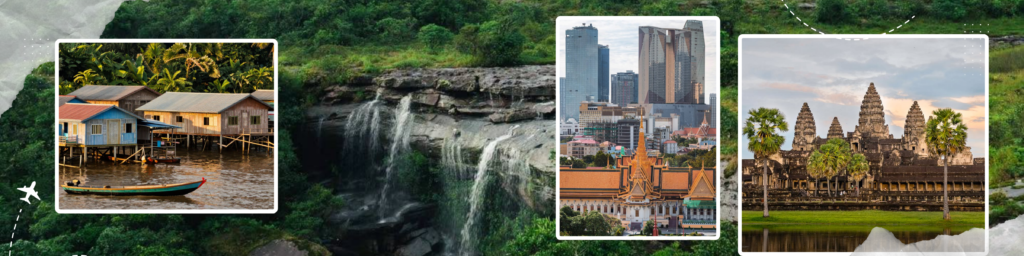
- Diversify beyond Angkor into underused assets. Holds up, and is the item most directly tied to the coordination gap. Industry figures have pointed to specific underused assets – Kampong Phluk’s floating village among them – and called for developing adventure, nature-based, agricultural, and handicraft tourism alongside the existing heritage offer. The individual ideas here aren’t the problem. Coordinating them is.
- Rebrand the tagline, or introduce site-specific sub-branding. Doesn’t hold up, either way. “Kingdom of Wonder” is still doing real work – the deficit is in how thinly it’s been backed, not the phrase itself. The Ministry’s own attempt at a new metaphor, “Frog Out of the Well,” was walked back within days of its July 2026 launch after public pushback – rebranding is harder to land than it looks, even for the Ministry itself. Site-specific sub-branding has the opposite problem: giving individual sites their own identities splits attention rather than adding to it. The stronger move is one consistent story – Angkor as the primary draw, with a credible “beyond Angkor” case built underneath it – not more names competing for the same attention.
- Fix visitor-experience complaints – pricing, service quality. Holds up, but its scope is often overstated. Addressing overpriced food, accommodation, and service quality improves what happens after someone decides to visit, which matters for repeat visits and word of mouth. It doesn’t by itself explain why fewer people are deciding to come in the first place.
What’s missing isn’t ideas – it’s coordination
None of this reflects a shortage of will or activity. Cambodia has already rebranded its low season as a year-round “Green Season,” rolled out an e-arrival system, piloted visa-free entry for China, cut Angkor ticket prices, and begun building a tourism app – alongside the individual industry proposals above.
What’s missing is a framework that ties these efforts, and the ones still worth pursuing, into one coherent story – one that shows Cambodia has something to offer across its provinces and throughout the year – so they compound rather than compete for a traveler’s attention. That’s the same fragmentation, pursued piecemeal on every side – government, industry, and commentary alike – that produces the noise each of these fixes is separately trying to cut through.
A few observations
An alarmed reading of an imperfect number risks scattering effort across disconnected fixes, however individually sound, rather than sequencing them inside something coherent. The slower work of building that architecture is also the one most likely to move the number that actually matters – and it takes the kind of patience a calmer read of the data affords, rather than a reactive scramble for quick wins.
Sources: Khmer Times, “What should Cambodia do to revive tourism amid sharp drop in visitors?” (Jul 2026); Khmer Times, “Foreign tourist arrivals drop nearly 50 percent in Jan-May period” (Jul 2026); Phnom Penh Post, “Tourism ministry walks back ‘Frog Out of the Well’ campaign after public feedback” (Jul 2026); Cambodia Ministry of Tourism, Tourism Statistics Reports, January 2024–May 2026; Cambodia Investment Review, “Every Neighbour’s Tourism Grew This Year. Cambodia’s Fell by Half” (Jun 2026); Al Jazeera, “Airlines hike fares, cut millions of seats as Iran war drives up fuel costs” (May 2026); Agence France-Presse, via Khmer Times, “Hun Manet vows to eradicate ‘black economy’ as Cambodia cracks down on online scam networks” (Feb 2026); CNBC, “Cambodia’s tourism sector takes a hit from geopolitical tensions and scam hub stigma” (Feb 2026); Cambodianess, “Rebuilding Trust, Expanding Destinations: Cambodia’s Tourism Roadmap for 2026” (Jan 2026); Khmer Times, “How is Cambodia’s turnaround strategy reviving tourism sector?” (Dec 2025).